Client Success as demand engine.
Why your client relationships are a financial system, not just a service function.

Client Success is the pillar most founders manage by feel. It is also the one that determines whether the revenue your Financial Operating System was built around will still be there next month.
The Financial Series closed with a complete picture of how profit is designed, defended, and delivered. Four instruments. Four economic filters. A system that governs how every dollar of revenue flows through the business and what reaches you as the owner.
But that system depends on one thing the instruments cannot produce on their own: revenue that is reliable enough to plan around.
This is where Client Success begins.
The financial architecture you build is only as strong as the revenue flowing into it. A business with a beautifully designed Financial Operating System and an unstable client base is a well-engineered structure sitting on sand. The margins hold until a major client leaves. The cash runway projections hold until two clients decide not to renew in the same month. The profit target holds until the revenue it was built around stops arriving on schedule.
Most founders know this feeling without having named it structurally. The month the numbers look right. The month they do not. The quiet anxiety of not knowing, with any precision, which it will be next time.
The quiet anxiety of not knowing which it will be next time traces back to the same place every time. The client pillar has no measurement system underneath it, and the financial results are where that gap finally shows up.
CLIENT SUCCESS IS NOT WHAT MOST FOUNDERS THINK IT IS
Client Success is not a service function. It is not the part of the business that makes clients feel good about working with you. It is not relationship management in the warm, informal sense that most founder-led businesses practice it.
Client Success is a revenue intelligence system. It is the pillar of the Alt Business Performance Framework that manages the two most important questions a founder-led business must be able to answer at any point in time: which clients are growing in value, and which are at risk of leaving before that risk shows up in the numbers.
Those are financial questions. And they require both qualitative and quantitative systems running together to answer them with any precision.
THE TWO SIDES OF CLIENT SUCCESS
The qualitative side is what most founders already do in some form. They know which clients are happy. They sense which ones are drifting. This is not nothing. Instinct built from real experience has genuine signal in it.
The problem is that instinct does not scale. It does not survive a team. It cannot tell you, in specific financial terms, what the risk of losing a particular client means for your revenue, your margin, and your PULSE reading next quarter.
The quantitative side is what most founders are missing entirely. Three numbers sit at the foundation of Client Success as a financial system.
THE THREE QUANTITATIVE METRICS
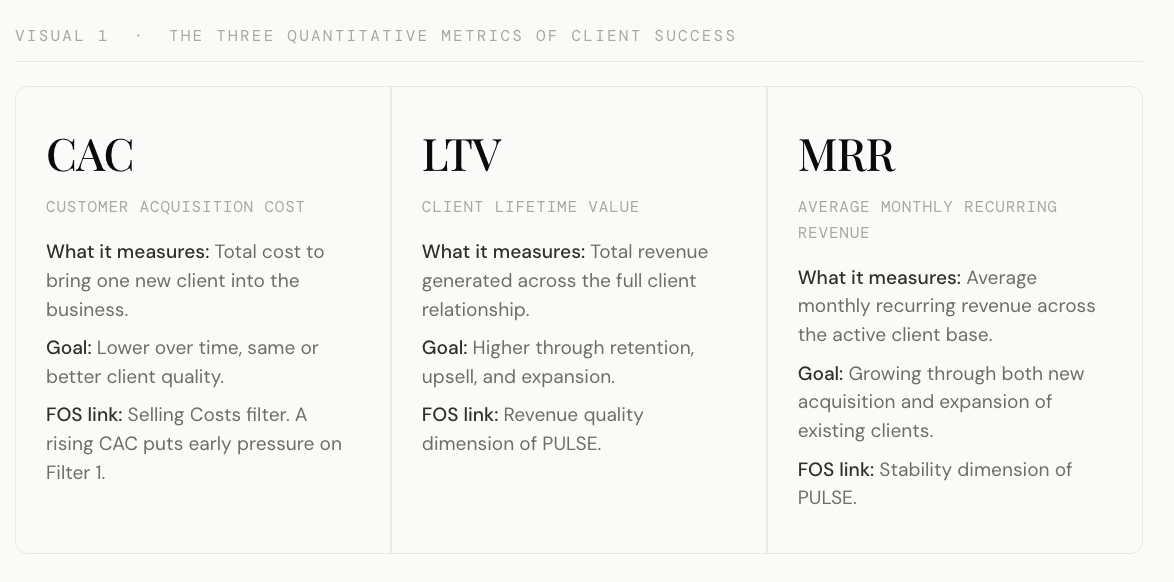 CAC, or Customer Acquisition Cost, is the total cost of bringing a new client into the business. Every peso or dollar spent on marketing, sales, business development, and the time your team invests in converting a prospect into a paying client. The goal is to reduce CAC over time while maintaining or improving the quality of the clients you acquire. A rising CAC against flat or declining revenue is one of the earliest signals that the Selling Costs filter of your Financial Operating System is under pressure.
LTV, or Client Lifetime Value, is the total revenue a client generates across the full length of their relationship with the business. The goal is to grow LTV through retention, upsell, and expansion. A business with a high LTV relative to its CAC has a client base that is compounding. A business where LTV is low and CAC is high is on a treadmill, spending to acquire clients who do not stay long enough to generate the return the acquisition cost requires.
Average MRR, or Average Monthly Recurring Revenue, is the average monthly recurring revenue across the active client base. The goal is to grow Average MRR over time, through both new client acquisition and expansion of existing relationships. A declining Average MRR is not always visible in total revenue, especially when new clients are masking contraction in the existing base. That masking is one of the most dangerous financial positions a founder-led business can be in without realizing it.
WHY THE QUALITATIVE AND QUANTITATIVE MUST RUN TOGETHER
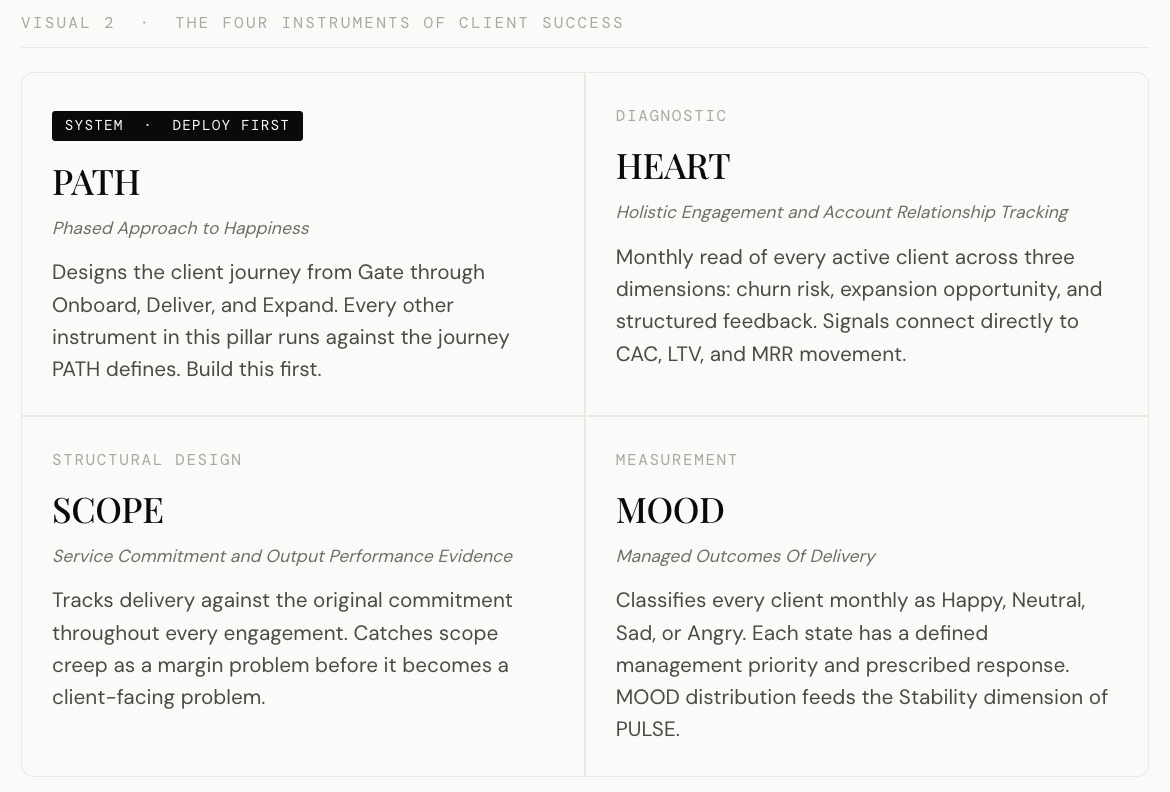 The qualitative instruments you will meet in this series, HEART, PATH, SCOPE, and MOOD, produce signals. They tell you which client relationships are healthy, which are at risk, which are delivering on the original commitment, and which require immediate attention.
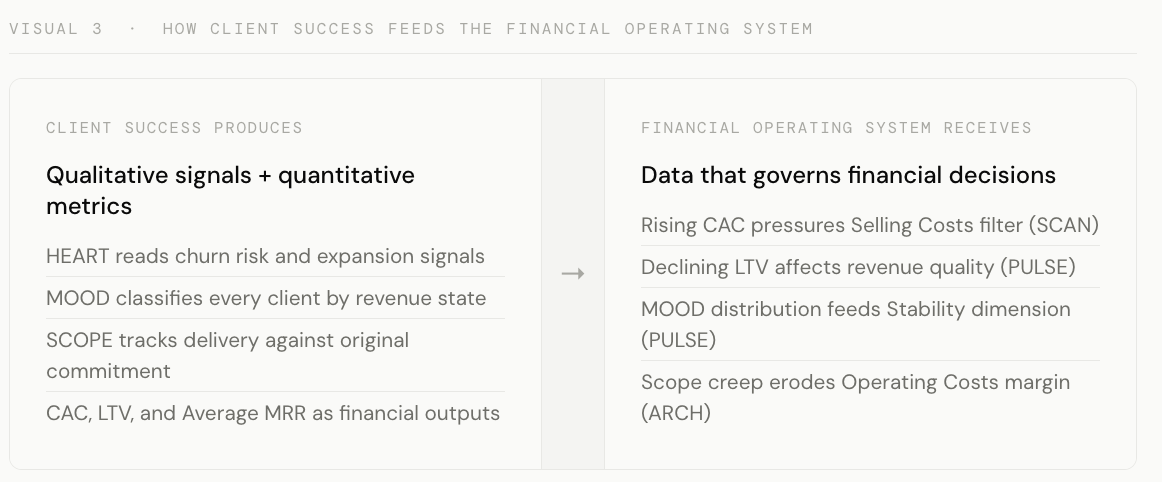
But signals without financial consequence are incomplete. When a HEART reading flags a client as disengaged, the question that follows is not just how do we fix this relationship. It is what does losing this client do to our Average MRR, our LTV calculation, and the Stability dimension of our PULSE reading this month.
And the quantitative metrics without qualitative instruments are just as incomplete. A declining Average MRR tells you something is wrong. It does not tell you which clients are responsible, why they are contracting, or what the correct intervention is.
The instruments find the signal before the number moves. The numbers tell you what the signal is worth.
Together, they give you something neither can produce alone: the ability to act on a client risk before it becomes a revenue event, and the ability to identify an expansion opportunity before a competitor does.
 ---
---
ONE THING TO SIT WITH THIS WEEK
Right now, without looking at any data, answer these three questions as honestly as you can.
What is your average client lifetime value? Not a guess. An actual number based on actual client history. What did it cost you, in total, to acquire your last three clients? And is your Average MRR across your active client base growing, flat, or declining?
If you cannot answer all three with confidence, you are managing your most important revenue asset by feel. That is where this series begins.