The Financial Operating System is complete.
How SCAN, IPT, ARCH, and PULSE work together to produce Protected Profit.

The Financial Operating System brings together SCAN, IPT, ARCH, and PULSE to design, protect, and deliver profit through a structured and measurable system.
Nine weeks ago, we started with financial fragility. Today, you understand the complete Financial Operating System.
We began with the Four Economic Filters, the architecture through which every pound or dollar of revenue passes on its way to becoming profit. We introduced Protected Profit, the destination where profit is designed, defended, and delivered to you as the owner. And we built the four instruments that produce it.
This issue closes the Financial Series and ties every piece together.
WHAT WE COVERED
The series covered four foundations of financial architecture.
The Four Economic Filters. Selling Costs, Operating Costs, G&A, and ITDA. Every business has all four. In a reactive model, revenue flows down through them and profit is whatever emerges. In a designed model, you start at the bottom with the profit you intend to keep and build upward through the filters with ceilings that protect that number.
Protected Profit. The destination of the Financial Operating System. Designed before you spend. Defended by the systems that protect it when conditions change. Delivered to you as the owner because the ITDA filter was managed deliberately rather than absorbed by debt service and surprise tax positions.
The Financial Operating System. The economic architecture that governs how revenue flows through the filters and what reaches you as profit. Not a P&L reviewed after the fact. A live system that tells you in real time whether every decision you are making will protect or erode the profit target you have designed.
The four instruments (Issues 12 through 16). Each one with a specific function in the complete system.
THE COMPLETE INSTRUMENT SUITE

HOW THE INSTRUMENTS WORK TOGETHER
The four instruments are not independent tools. They are a workflow. Each one feeds into the next and the system only produces Protected Profit when all four are operating together.
SCAN finds the leaks. Before you build anything, SCAN examines the current cost structure across all four economic filters. It produces a ranked intervention priority: this filter, this amount, this urgency. You know exactly where the margin is disappearing before you spend effort trying to fix the wrong thing.
IPT sets the target. The Inverted Profit Triangle establishes what the business is designed to keep. Not discovered at year end. Decided at the beginning. Net profit is the starting point, and every filter ceiling is calculated from that number outward. The IPT target is the reference point for every subsequent decision.
ARCH builds the structure. Taking the SCAN findings and the IPT target together, ARCH constructs the financial architecture. Every cost is mapped to its filter, classified, evaluated against the return it produces, and sized against the ceiling its filter can sustain while protecting the designed profit. Costs below threshold are cut. Costs above threshold are protected. Recovered capital is deployed where return is highest.
PULSE measures the health. Once the structure is built, PULSE runs monthly across five dimensions: Profit, Utilization, Liquidity, Stability, and Earnings. Any dimension below threshold triggers a defined response. Not a general review. A specific intervention because the dimension that triggered the response is already identified and classified.
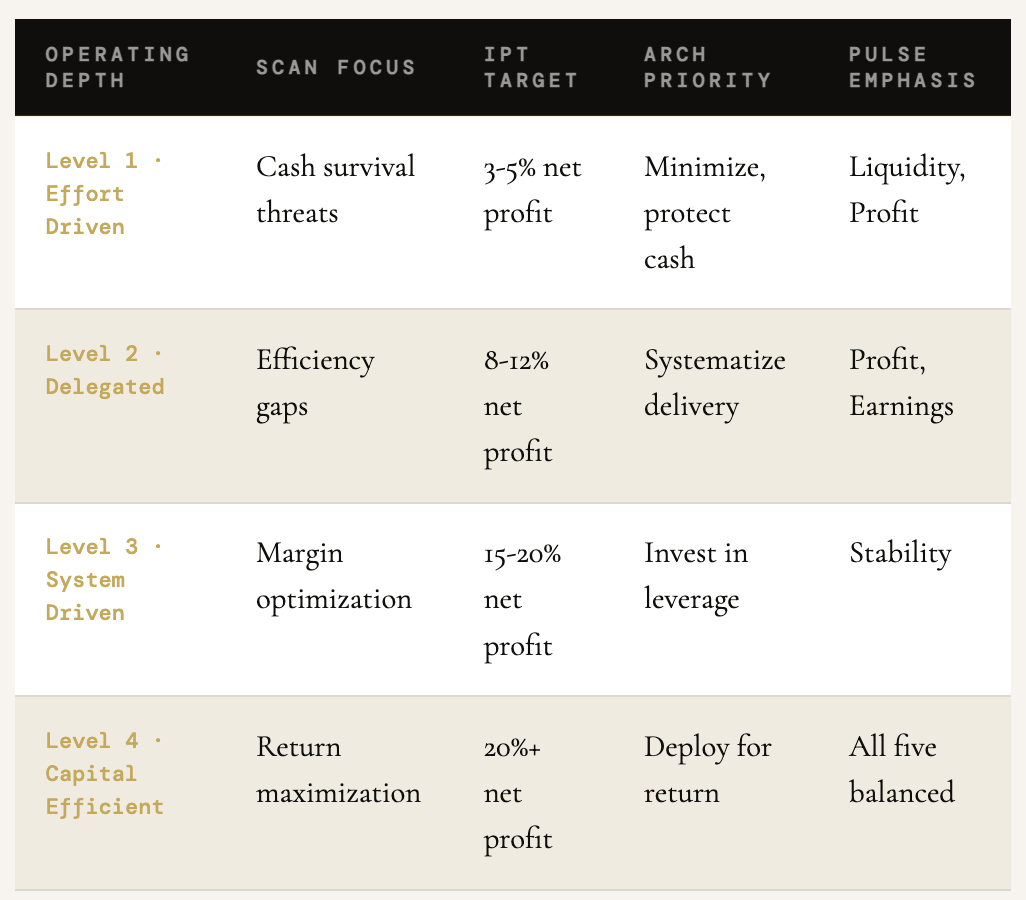
BY OPERATING POSITION
The Financial Operating System looks different depending on where the business sits. The instruments are the same. The priorities shift.
 ---
---
PROTECTED PROFIT IS ACHIEVED WHEN
- Designed. IPT has set the net profit target before the year starts. The target is not a hope or a projection. It is a decision. Every filter ceiling has been calculated from that number and every cost commitment has been evaluated against those ceilings.
- Defended. SCAN is running and catching leaks before they compound. ARCH has built the cost structure around the target and classified every cost so that cuts do not remove value and protections do not shield waste. The financial architecture holds when conditions change.
- Delivered. PULSE confirms, monthly, that net profit is reaching the owner through the ITDA filter. The designed profit is not being absorbed by interest obligations the business did not plan for. The tax position is managed. What reaches you is what was designed to reach you at the beginning of the year.
PROFITABILITY HEALTH RISK ASSESSMENT
The Financial Series closes with five questions. Run these quarterly. They are the Profitability Health Risk Assessment for your Financial Operating System.
- One. Is PULSE running monthly? Not occasionally. Not when something feels wrong. Monthly, on the same date, across all five dimensions. A Financial Operating System that is not measured is not operating.
- Two. Is the profit gap to the IPT target narrowing or widening? A gap is expected when the system is new. What matters is the direction. Narrowing means the structure is working. Widening for two consecutive months means something in the system has broken and SCAN needs to run.
- Three. Is cash runway above three months? The minimum operating buffer for a Financial Operating System that is functioning. Below three months, the system shifts from optimization to survival and every instrument recalibrates accordingly.
- Four. Is revenue quality stable or deteriorating? Predictability, concentration, and margin by stream. If the top two clients represent more than forty percent of revenue, or if a key revenue stream is producing below the gross margin threshold, the financial architecture is more fragile than the net profit number suggests.
- Five. Is owner return being delivered by design? Not as a residual. Not as what was left after everything else. As the number that was decided at the beginning of the year and that the ITDA filter was managed to protect. If the answer is no, the Financial Operating System has the architecture but the ITDA layer is not yet part of the design.
THREE THINGS TO CARRY FORWARD
The Four Economic Filters. Know where profit flows and where it leaks. Every financial decision you make sits inside one of the four filters. Naming it is the first step toward managing it.
Protected Profit. Designed, defended, delivered. Not discovered. Not hoped for. If your profit is not meeting all three criteria, the Financial Operating System has a gap. Use the instruments to find it and close it.
Operating Position. The right decisions at the right level for where your business actually sits. The instruments are the same at every level. The priorities, thresholds, and strategies change. Calibrate to where you are, not where you want to be.
Profit is not what is left over. It is what was designed to reach you.
The Financial Operating System is how that happens. Nine issues. Four instruments. One destination: Protected Profit.
Thursday, we begin the Client Success series, the demand engine that makes revenue predictable. The financial architecture you have built this series needs revenue to work. Next series builds it.