Financial Clarity: Understand Your Numbers. Own Your Decisions.

Most business owners know their bank balance. Very few actually know their numbers. Financial statements were designed by accountants, for accountants. Nobody walked you through what a profit and loss statement is actually telling you, or what happens to your cash between the moment a sale is recorded and the moment it arrives in your account. Confidence with your numbers is not a personality trait. It is a skill. It is learned the same way every other business skill is learned: with the right information, in the right order, applied to your actual situation. Financial Clarity, built within the Alt Business Performance Framework, is where that foundation gets built.
Most business owners know their bank balance. Very few actually know their numbers. There is a difference between checking if there is money in the account and truly understanding your financial position, and that difference is costing businesses every single day.
The gap is not about intelligence or discipline. It is about access. Financial statements were designed by accountants, for accountants. Nobody sat down at the start of your business and walked you through what a profit and loss statement is actually telling you, or why your balance sheet matters, or what happens to your cash between the moment a sale is recorded and the moment it arrives in your account. You learned everything else about running your business. You were never formally taught this.
That is the problem Financial Clarity, built within the Alt Business Performance Framework, is designed to solve.
What you are actually looking at when you look at your numbers
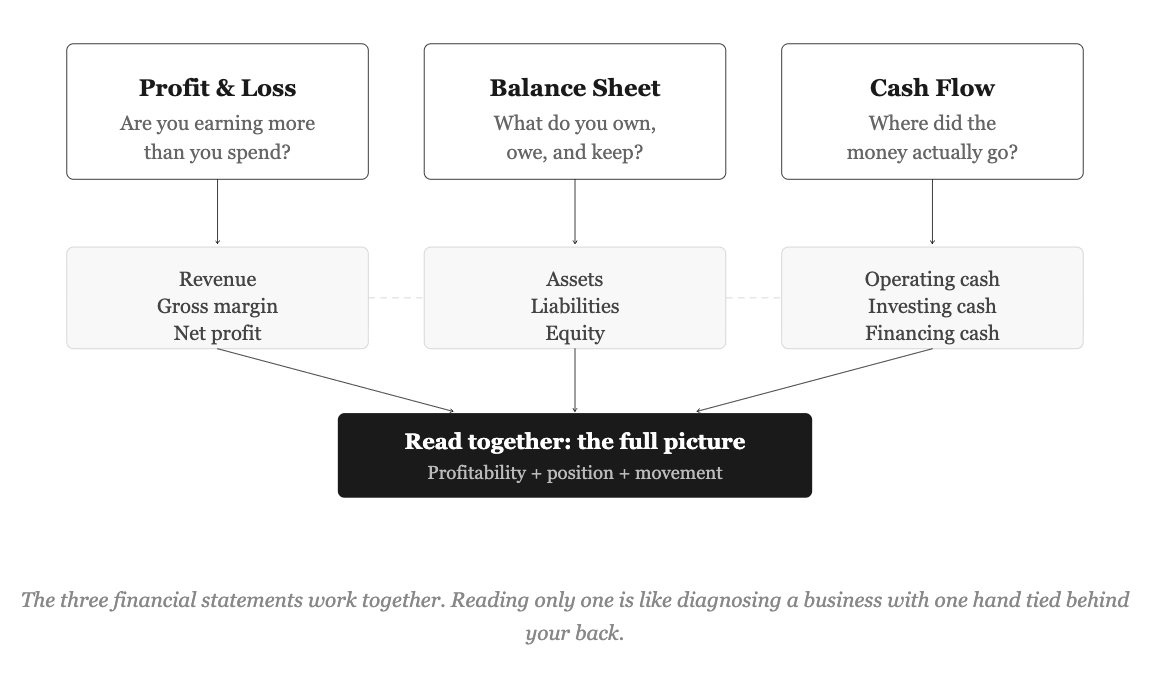 Your financial statements are not bureaucratic paperwork. They are a live report on the health of your business. Your profit and loss statement tells you whether the business is earning more than it spends. Your balance sheet tells you what the business owns, what it owes, and what is left over. Your cash flow statement tells you where money actually went.
The issue is that most business owners only ever look at one number: the bank balance. The bank balance is a snapshot. It does not tell you whether last month was profitable. It does not tell you whether a large payment is about to land that will change everything. It does not tell you whether your expenses are creeping up faster than your revenue. It is one data point in a story that needs three chapters to make sense.
When you learn to read all three statements together, you stop reacting and start managing. You stop wondering why there is no money despite all the sales. You stop making pricing decisions based on guesswork. You stop paying yourself whatever is left over and hoping it covers the month.
The numbers that are quietly hurting you
There are always a few numbers doing the most damage, and they are rarely the ones business owners are watching. Gross margin is one of them. It tells you how much of every sale the business actually keeps after direct costs. A business with strong revenue and thin gross margins is a business working very hard for very little. Most founders have no idea what their gross margin is.
Accounts receivable is another. If you invoice clients and wait to be paid, money is sitting in that account that you cannot use. The Alt Business Performance Framework treats receivables not just as a ledger item but as a signal: how long is money taking to move from sale to cash? The longer it takes, the more pressure it puts on every other part of the business.
Operating expenses are the third area that consistently surprises founders. Expenses do not feel large individually. Collectively, they are almost always larger than expected. Subscriptions, software, small recurring costs, fees buried in payment processing, supplies that feel too small to track. When you lay them all out, the picture is usually uncomfortable and immediately actionable.
This is the work. Not complicated formulas. Not advanced accounting. Reading the right numbers, in the right order, and understanding what they are telling you about the business you are actually running.
The decision problem
Financial decisions made without financial clarity are not really decisions. They are guesses with money attached. Should you hire? Should you raise your prices? Should you take on a big client at a lower rate? Should you invest in new equipment? All of these questions have answers in your financial statements. Without clarity, they are answered by instinct, and instinct has a poor track record when the numbers tell a different story.
The Alt Business Performance Framework approaches financial clarity not as a starting point for compliance but as the foundation for every business decision that follows. Before you can fix your pricing, you need to know your margins. Before you can pay yourself properly, you need to understand your true operating costs. Before you can manage your cash flow, you need to know the difference between revenue and cash. Financial Clarity is where that foundation gets built.
What you leave with
This session is built around completed work, not passive learning. You will finish with worksheets that capture your actual numbers, the ones specific to your business, not hypothetical examples. You will know how to read your profit and loss statement without needing a translator. You will be able to look at your balance sheet and understand what it is signaling. You will have a list of the specific numbers that matter most to your business and a clear sense of where to look first when something feels off.
Confidence with your numbers is not a personality trait. It is a skill. It is learned the same way every other business skill is learned: with the right information, in the right order, applied to your actual situation.
The practical starting point: pull your profit and loss statement for the last three months. Find your gross margin line. If it is not there, find your revenue and subtract your direct costs. That number, as a percentage of revenue, tells you how much the business keeps from every sale. If you do not know it, that is the first thing to fix. Everything else in the business is downstream of that number.