The profit problem. Why your business earns well and keeps less than it should.

Most founder-led businesses generate real revenue but produce less profit than they should. The Alt Business Performance Framework explains why, and what to build instead.
You built something real.
The revenue is there. The clients are there. The team is there. By every visible measure, the business is working. And yet the profit at the end of the month, the end of the quarter, the end of the year, is never quite where it should be. Not catastrophically wrong. Just consistently less than the effort invested suggests it ought to be.
Most founders carry this feeling for longer than they should before they name it. Because from the outside, everything looks fine. And from the inside, it is hard to know whether the problem is a bad month, a structural gap, or something in between.
Almost always, it is structural.
THE PROBLEM IS NOT WHAT MOST FOUNDERS THINK IT IS
The instinct, when profit is low, is to look at revenue. Grow the top line. Win more clients. Close more deals. If there is more coming in, more will stay.
This is the most expensive assumption in founder-led business. A business that is not generating the profit it should at its current revenue level will not generate the profit it should at a higher revenue level. The margin percentage stays the same on a larger number.
The problem does not shrink with growth. It scales with it.
Most founder-led businesses are not designed. They are built. And there is a difference that matters more than most founders realize until they are well into the growth they were chasing and the profit still has not followed.
A business that is built grows by responding to what is in front of it. A client needs something, you deliver it. The team needs direction, you provide it. A cost appears, you absorb it. Revenue comes in, you spend what the business needs and keep what is left. Profit is discovered at year end. Sometimes it is satisfying. Often it is not. Always it is a surprise.
A business that is designed works differently. Profit is not discovered. It is decided. Before the year starts. Before the spending begins. Before a single new client is acquired or a single new team member is hired. The number is set first, and every other decision is evaluated against whether it protects or erodes that number.
That single inversion changes the quality of every financial decision the business makes.
TWO CAPITALS MOST FOUNDERS UNDERESTIMATE
There is a reason the profit problem persists even in businesses with strong revenue, capable teams, and experienced founders. The gap almost always traces back to the same place: the absence of systems around the two most important and most difficult capitals in any founder-led business. Clients and employees. These are not resources in the abstract sense. They are the engine and the delivery mechanism of everything the business produces. Clients generate the revenue the financial architecture is built around. Employees determine whether the business can deliver on what the revenue represents. When both are managed well, and managed together, the business produces profit consistently. When either one breaks down, the financial results follow, usually before the founder can see why.
Most businesses manage both of these relationships informally. Clients are managed through the founder's instinct, personal relationships, and accumulated knowledge of which ones are happy and which are not. Employees are managed through proximity, observation, and the founder's ability to be present in enough decisions to keep quality consistent.
This works until it does not. And it stops working at exactly the moment the business needs it to work most: when the founder is less available, when the client base grows beyond what one person can hold in their head, when the team reaches a size where personal oversight cannot substitute for structure.
The Alt Business Performance Framework was built for this moment.
WHAT THE FRAMEWORK IS
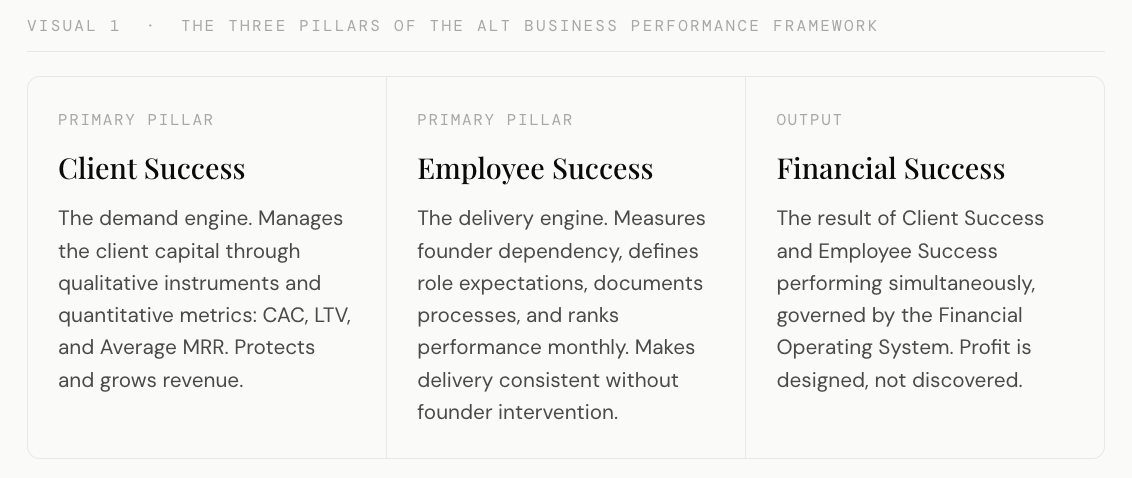 The Alt Business Performance Framework is an operating system for founder-led businesses. It is built on three pillars and governed by one connective layer.
The two primary pillars are Client Success and Employee Success. These are the systems that manage the two most important capitals in the business. Not as soft functions. As revenue intelligence systems with both qualitative and quantitative measurement running simultaneously.
Client Success is the demand engine. Sales acquires revenue. Client Success protects it, grows it, and turns it into the kind of income the business can plan around. It does this through four instruments that monitor relationship health, design the client journey, track delivery against commitment, and classify every client by state so the business always knows where its revenue portfolio stands. And it does this alongside three financial metrics, Customer Acquisition Cost, Client Lifetime Value, and Average Monthly Recurring Revenue, that connect every qualitative signal to a financial consequence.
Employee Success is the delivery engine. It determines whether the business can do what it has promised to do, consistently, at the standard the client expects, without the founder being the mechanism that holds it all together. It measures founder dependency as a percentage of total decisions and works to reduce that number month on month. It defines role expectations, documents every process the business depends on, and ranks team performance on a consistent cadence so that the business knows which people to invest in and which need structured support.
The connective layer is the Financial Operating System. This is the architecture that makes the other two pillars financially accountable. Every metric produced by Client Success and Employee Success flows back into it. It governs how revenue passes through the four economic filters of the business, Selling Costs, Operating Costs, General and Administrative expenses, and Interest, Tax, Depreciation and Amortization, and determines what reaches the owner as profit. It is managed through four instruments: SCAN, which locates exactly where profit is leaking and by how much; IPT, the Inverted Profit Triangle, which sets the profit target first and sizes every cost backwards from it; ARCH, which builds the complete financial structure from those findings; and PULSE, which measures financial health across five dimensions every month so no risk is visible only in isolation.
Financial Success is the output of all three working together. The result of Client Success and Employee Success performing simultaneously, governed by a Financial Operating System that was designed before the year began.
THE OPERATING POSITION
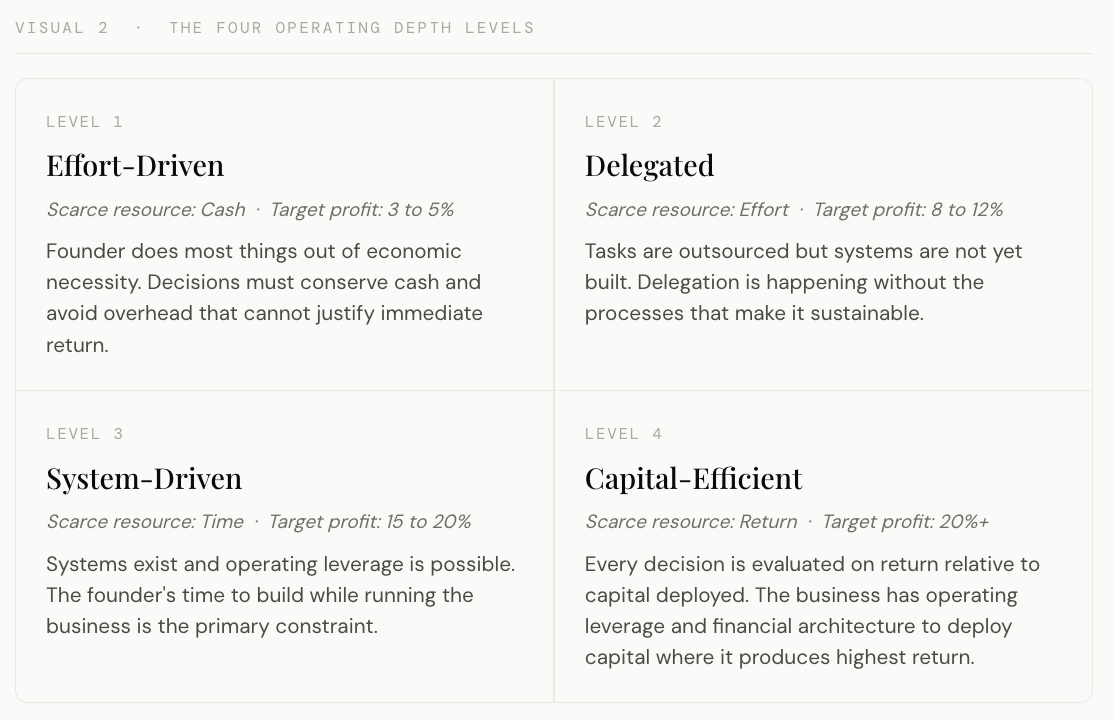 Every business sits at a specific position. Not a strategy. Not a goal. An actual position: where it is right now, relative to where it needs to get to. And the decisions that are correct at one position are actively damaging at another.
The Alt Operating Position has two dimensions. Operating Depth measures how built the business is as an operating entity, from Effort-Driven at Level 1, where cash is the scarce resource and the founder carries most of the operational weight, through Delegated at Level 2, System-Driven at Level 3, and Capital-Efficient at Level 4. Operating Focus measures what the business needs most right now: Stability when cash is the constraint, Scalability when effort is the constraint, Capital Efficiency when time and return are the constraint.
The intersection of these two dimensions determines what every correct decision looks like. A Level 1 business in Stability cuts costs and conserves cash. A Level 3 business in Scalability invests in systems that multiply what it already produces. A business making Level 3 decisions while sitting at Level 1 does not accelerate. It collapses under overhead it cannot yet support.
This is why so many founder-led businesses stall at exactly the moment they expected to break through. The decisions were not necessarily wrong in principle. They were made at the wrong position.
The Cost Optimization Matrix inside the framework maps the Operating Position to the correct resource allocation strategy. It takes the three finite resources every business operates with, cash, effort, and time, and tells the founder what to cut, what to optimize, and what to invest in given where the business actually sits.
THE DESTINATION
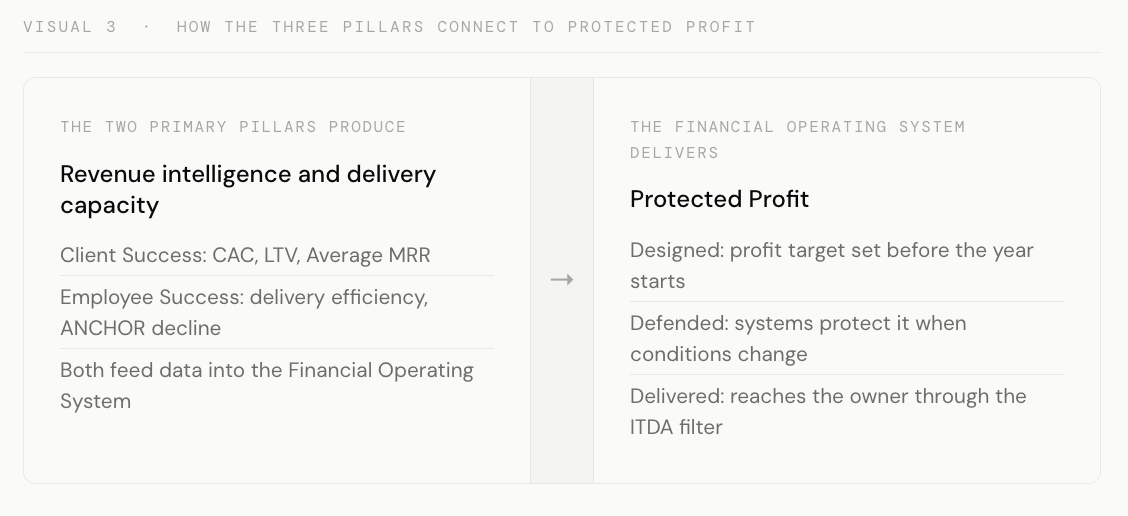 The Alt Business Performance Framework is built toward one outcome: Protected Profit.
The state where a business generates profit that is designed into its structure, defended by its systems, and delivered to the owner in a form they can actually use. Not discovered at year end. Not hoped for after costs are paid. Designed before the year begins, defended by the instruments that protect it when conditions change, and delivered because the financial architecture was built to ensure it reaches the founder who built the business.
This is what separates a business that earns from a business that keeps. Revenue is what the business generates. Protected Profit is what the founder receives. The gap between them is structural. And structure can always be redesigned.
WHERE TO GO FROM HERE
The Business Architect is an ongoing series published twice a week on aireeza.com.
Every issue covers one concept from the framework in practice. The specific thinking that makes the next decision easier to get right.
The series is structured around the framework itself. Client Success and Employee Success are the two primary pillars, the clients who generate the revenue and the employees who deliver it. The newsletter covers both in depth: how client relationships become a revenue intelligence system with qualitative instruments and quantitative metrics running together, and how the delivery engine is built so that output is consistent and founder dependency declines month on month. Running underneath both is the Financial Operating System, the connective layer that governs how the data from both pillars flows into profit decisions. The Financial Series covered its four instruments in full. And the architecture series ties everything together, covering the Operating Position and the Cost Optimization Matrix that tells a founder what decisions are correct given where the business actually sits.
Every issue is available in the archive. Start anywhere. The series is designed to build on itself, but every issue stands on its own.
If you are a founder running a business with real revenue and a profit problem you have not yet been able to locate, this is written for you.
Follow along on LinkedIn where the thinking behind the work is shared regularly. And subscribe to The Business Architect to receive every issue as it publishes, twice a week, no filler, built to last.