What is Protected Profit and why most founders never reach it.

Protected Profit is not a number on a financial statement. It is the operating state where profit is designed into the business before the year begins, defended by systems, and delivered to the owner in a form they can actually use.
Most founders who run profitable businesses on paper have never actually reached Protected Profit. Not because the revenue is not there. Because the profit was never designed into the business in the first place.
Protected Profit is an operating state. The state where profit is designed into the structure of the business before the year begins, defended by systems that hold it in place when conditions shift, and delivered to the owner in a form they can actually use. Not discovered at year end. Not whatever is left after every other obligation is paid. Designed, defended, and reaching the founder who built the business.
That distinction matters more than most founders realize until they are well into growth and the profit still has not followed.
 ---
---
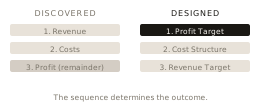
DISCOVERED PROFIT IS THE DEFAULT
The business grows by responding to what is in front of it. A client needs something, you deliver it. A cost appears, you absorb it. Revenue comes in, spending follows, and profit is whatever remains at the end of the period. Some months it is satisfying. Most months it is not. Almost always it is a surprise.
A business not producing the profit it should at its current revenue level will not produce it at a higher one. The structural problem scales with the revenue.
This is discovered profit. And it persists not because of poor financial management, but because of an absence of structure.
The quiet assumption underneath it is that more revenue will eventually solve the problem. If there is more coming in, more will stay. This is the most expensive assumption in founder-led business. A business not producing the profit it should at its current revenue level will not produce it at a higher one. The margin percentage does not improve with scale. The structural problem scales with the revenue.
Reaching Protected Profit is not about growing faster. It is about building the architecture that ensures profit is decided before it is spent.
DESIGNED, DEFENDED, AND REACHING THE OWNER
Designed means the profit target is set before the year begins, before a single cost is committed or a new client is acquired, and every financial decision is evaluated against whether it protects or erodes that number. The Alt Business Performance Framework, the methodology behind this work, is built on one inversion: start with the profit and build the cost structure backwards from it. Most businesses do the opposite. They accumulate costs and discover what is left.
Defended means having the systems in place to locate where profit is leaking, monitor financial health across multiple dimensions at once, and respond before a single bad quarter becomes a structural problem. The framework governs this through a financial operating system that runs continuously, not just at year end, so that no risk sits in isolation long enough to become a crisis.
Reaching the owner is the characteristic most founders have never actually experienced. Profit that exists on a statement but is absorbed by reinvestment, cash flow gaps, or operating obligations that were not planned for is not Protected Profit. The architecture has to be built so that what was designed actually travels through the business and arrives in a form the founder can use, on a timeline the founder can plan around.
THE POSITION THE BUSINESS IS ACTUALLY IN
Most founders making decisions about their financial architecture are calibrating for a business they do not yet have.
The Alt Business Performance Framework accounts for this directly. Where the business sits determines what every correct decision looks like. A founder who invests in infrastructure before the business can support it does not accelerate growth. They create overhead that erodes the profit they were trying to protect. A founder who keeps cutting costs in a business that has already stabilized and needs systems stalls at exactly the moment they expected to break through.
The decisions were not necessarily wrong in principle. They were made at the wrong position. Reaching Protected Profit requires knowing where the business actually sits and making decisions that are correct for that position, not for the one it is headed toward.
WHAT ACTUALLY CHANGES
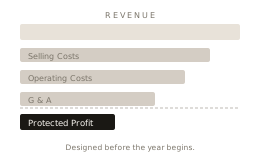 When the profit target is set first and the cost structure is built around it, every new expense, every new hire, every new commitment has a clear test: does this protect the number or erode it? That clarity does not eliminate hard decisions. It makes them faster and less expensive.
The business also stops depending on the founder to hold it together financially. Protected Profit requires structure around the two capitals that drive every financial result: clients and employees. When both are managed through systems rather than instinct, the business produces consistent results without the founder present in every decision. The profit becomes something the business generates, not something the founder extracts through sustained personal effort.
There is a third shift that is harder to describe until a founder has experienced it. The business starts to feel different. Not because the revenue has changed. Because the outcome is no longer a surprise.
PRACTICAL TAKEAWAY
Before anything else can be built, the profit target has to exist. Not as an aspiration, as a specific number set before the year begins, that every financial decision in the business is evaluated against. If that number does not exist yet, start there.
Once that number exists, the next question is where profit is already leaking. In most founder-led businesses, profit does not disappear all at once. It leaks quietly through specific places in the business before it ever reaches the owner. That is where we go next.